December 15, 2008 Categories: Reviews
Creating Vibrant Public Spaces: Streetscape Design in Commercial and Historic Districts
2008. Island Press. 215 pp. $35.
If you want a book that explains why people like traditional urban design, read Ned Crankshaw’s Creating Vibrant Public Spaces. If you just want a book with specific ideas about designing for surface parking that enhances neighborhood and small-city commercial districts, read Ned Crankshaw’s Creating Vibrant Public Spaces. If you want some thought-provoking reflections on the tensions between good design and historic preservation, read Ned Crankshaw’s Creating Vibrant Public Spaces.
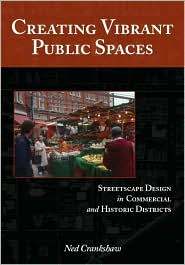
Few authors pack this much punch into so few pages. (And if you don’t believe me, you can read the first 22 pages for free at Google Book Search.) Crankshaw, who teaches landscape architecture at the University of Kentucky, starts with a chapter called, “A Philosophical Basis for Downtown Design,” which rests on four basic design imperatives:
(1) Balance familiarity and intrigue, because people want both “a level of complexity that will keep [them] involved in a place and a level of predictability that will help [them] stay oriented and comfortably master a location.” {4} As Crankshaw says, nobody advertises “Visit Our Predictable Downtown,” but at the same time nobody enjoys being completely disoriented.
(2) Balance prospect and refuge, because people want both to see what’s going on and to be able to get out of it if necessary. “A street that affords a high degree of refuge would have a street wall that appears to be easily penetrated and a sheltering edge that continues with few interruptions. A street that affords a high degree of prospect would have reasonable open views along its length and would perhaps connect into other open spaces.” {15} In nature and landscape design, savanna-type (“parklike”) landscapes usually satisfy this need best. (That’s why it’s good for long blocks to have permeable buildings rather than blank walls!) Scary places are those that are all one way or all the other: a sidewalk threading its way between a busy arterial street and a parking lot is all prospect and no refuge, while the inside of a parking deck is all refuge and no prospect. {20}
(3) Maintain a compact mix of land uses with short walkable connections between them — which ties in with from 1 and 2.
(4) Use materials and forms that authentically express various ages of buildings and landscapes. This too is a balancing act, because of the central dilemma of preservation: “Preservation is motivated by the urge to maintain something with authenticity, but the act of preservation creates varying levels of artificiality in the artifact.” {22} Crankshaw describes an extreme case of this — when a 1940s garden club deliberately added to Henry Clay’s mansion an elaborate garden unlike anything there before — but simply designating a place as historic or repairing it begins a process of change. “That physical change will inevitably take away some level of authenticity or genuineness,” he writes. “No matter how carefully thought out, preferences for particular historic time periods, biases toward certain styles, and the building technology of the period in which preservation takes place will have a standardizing effect.” {24} His message as I understand it is not to do nothing, but to be self-aware, and conscious at all times that you are not Henry Clay.
As the book goes on, Crankshaw moves from general principles to specific practices. His historical perspective helps, including the realization that classic downtowns usually date from the 1920s, a time when the automobile had increased local business traffic and caused commercial areas to densify, but had not yet led to the creation of outlying low-density development. And he’s willing to learn from more recent periods, paying tribute to the genius of shopping-center design, and finding ways for downtowns to approximate it while remaining true to themselves.
But expertise and professional knowledge isn’t everything. Crankshaw calls attention to how “designer’s eyes” can miss places valued by local inhabitants. In Manteo, North Carolina, locals identified as important some visually ordinary places including “the post office, a downtown boat launch, and a gravel parking lot that held many town festivals and the town Christmas tree.” {84} Later in the book, when Crankshaw takes up his home town of Winchester, he writes that “As a resident and a frequent visitor, I have discovered repeated patterns of experience that I would have disregarded if looking at the district with only a designer’s eyes.” {110} Designer’s eyes are necessary but not sufficient: a happy and common-sensical medium between modernists’ dogmatic claims to expertise and postmodernists’ dogmatic denial that any such thing exists.
The closest Crankshaw gets to being, well, cranky, is in his discussion of how historic preservation conventions can work (with the best of intentions) against their goal. Successful nominations of downtown historic districts focus on the best surviving examples, and exclude places (often on the edge of downtown) where historic and non-historic structures are mixed up together. “In other words,” he writes, “the area left out of the proposed district is the area most in need of assistance. Along with being a ‘poor representation,’ historically, it is probably a poor human environment in which the few remaining good buildings are isolated by desolate parking lots and leftover space. But the effect of district designation [nearby] will be to allow this area to continue to weaken, even as the designated area improves.” {36} Fix the Worst First!
His most intriguing insight in the later chapters is obvious if you think about it: “Each circulation pattern is a continuum that converts auto drivers to pedestrians and then back again. The point of conversion from driver to pedestrian is a significant change in the experience.” {111} Hence, “The walking experience after leaving a car in a parking lot should be as convenient as the auto access to the parking.” {178}
This thought grows naturally out of Crankshaw’s good-natured approach. Note how unlikely it would be to come from someone who used the antisprawl rhetoric about “designing for people, not for cars.” That language is shrill and inaccurate, intended to disgust, not inspire. As such it works to shut down the creative mind — to prevent it from recognizing that because people use cars, a walkable downtown needs (among other things) good connections between where people park and where they are going. Some will walk downtown from nearby neighborhoods (more, if good walkable transitions exist), but no downtown has ever derived its economic sustenance only from its immediate neighbors.
Crankshaw concludes with a lengthy but deliberately undogmatic set of guidelines for designing streetscapes and public spaces. “Design guidelines,” he writes, “do not remove the privilege of making design decisions; rather, they provide criteria for considering the appropriateness of specific design decisions involved in a project.” {168}
Creating Vibrant Public Spaces is neither a sacred text nor a movement manifesto. It’s a thoughtful, instructive, and inspiring book that should help designers find ways to do better work and enjoy it more.
#