February 26, 2009 Categories: Reviews
Retrofitting Suburbia: Urban Design Solutions for Redesigning Suburbs
Ellen Dunham-Jones and June Williamson
2009. John Wiley & Sons. 256 pp. $75.
If you stick it out in the suburbs, eventually urbanism may come to you. Coauthors Ellen Dunham-Jones, AIA, of the Georgia Institute of Technology, and June Williamson, RA, LEED-AP, of the City College of New York/CUNY, want to see it happen ASAP. While they pay much more than lip service to one-lot-at-a-time infill, they also defend big projects occupying 40 acres or more:
“We contend that….the zoning codes and land use practices that produced the conventional suburban form of the twentieth century are simply too entrenched and pervasive for piecemeal, incremental projects.” {viii} Whatever will reduce vehicle miles traveled (VMT) is their mantra, since that saves people money, builds community, reduces pollution, and cuts greenhouse gas emissions.
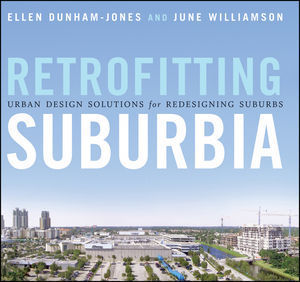
The authors’ sharp wits cut them a path through the jungle of egotism and controversy surrounding their subject. Their book’s two-part strucutre has its own pleasing asymmetry. The first part, “The Argument,” contains one chapter that sets the stage and introduces their terminology. The second part, “The Examples,” contains eleven chapters alternating between more general discussion and close-up analysis of case studies.
In turn they take up the various suburban landscapes that need retrofitting: garden apartments and residential subdivisions (case study: Levittown); commercial strips (case study: Mashpee Commons); regional malls (case studies: Cottonwood in Utah, Belmar in Colorado); edge city infill (case study: downtown Kendall/Dadeland); and office and industrial parks (case study: University Town Center in Prince George’s County, Maryland). These are not easygoing quick-draw case studies. Among other things, they include figure-ground diagrams of the same place spaced 20-40 years apart, showing which patterns resist change over time and which do not. The authors are no longer crying in the wilderness, they’re documenting and spurring on an established trend.
But is this a trend toward real urbanism? The authors warn against cheap shots. It’s easy to compare suburban retrofits to real cities, and find the reconstructed suburbs still “lacking the culture, excitement, diversity, conflict, grit, and suffering that coexist in core cities.” But they’re not core cities, they’re hybrids, neither prototypically suburban or urban. For example, they have
suburban parking ratios and urban streetscapes, privately owned public spaces, urban building types filled with suburban chain retail, new single-ownership parcels masked to appear old and multiparceled, transit orientation and auto dependency, local placemaking by national developers and designers.
But are these irreconcilable contradictions or evolving tensions? Is the glass half full or half empty? More to the point, is the glass continuing to fill? Time will tell. The authors, however, stoutly defend what’s happened to this point. “Although instant cities and suburban retrofits are neither as sustainable nor as urban as older established cities, they are more sustainable and more urban than the conditions they have replaced.” {14}
The authors also defend their emphasis on suburbs, for fix-the-worst-first reasons: “The focus for redevelopment should be those parts of the metropolis with the highest auto dependency and VMT, highest per capita greenhouse gas emissions and per capita runoff, and least diverse social, housing, and transportation choices.” {231} Of course these will also be the places where, at first, the glass may not even be quite half full. And the question remains, as they acknowledge, whether the urban glass will continue to fill, or will it halt halfway, blocked by NIMBYism centered on resisting diversity.
The authors’ detailed research is as thorough and provocative as their thinking. In a discussion of a development outside Charlotte, we learn that Whole Foods can be a breakthrough tenant, causing NIMBYism to melt away — but the giant organic retailer has its own unsavory baggage. “Whole Foods comes into a suburban project with a laundry list of nonnegotiable, antiurban demands…. In this case, Whole Foods required an exact number of dedicated parking stalls, configured to discourage shoppers from visiting other retailers while parked in their lot.” {35}
Big thoughts, small details, and ways to keep the process moving — this book has it all.
#